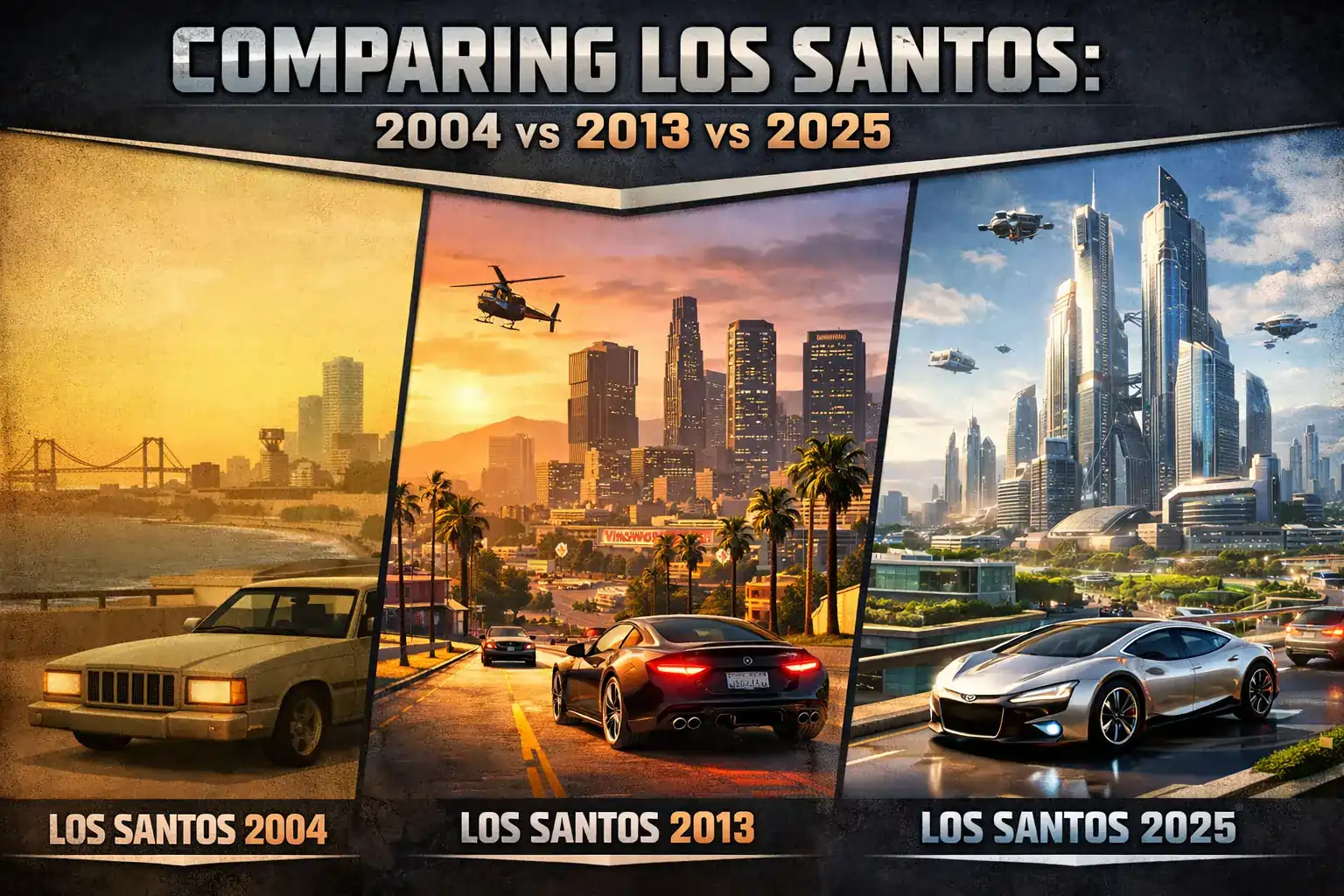
Los Santos isn’t just a city—it’s a time machine. One minute you’re driving a boxy Greenwood down Grove Street listening to Ryder complain about “watermelons,” and the next you’re launching a Oppressor Mk II off the Maze Bank Tower while avoiding a orbital cannon strike from a 12-year-old in Ohio.
Welcome to the weird, wonderful evolution of Los Santos across three distinct eras. When comparing Los Santos: 2004 vs 2013 vs 2025, we’re not just looking at texture upgrades and ray tracing. We’re witnessing the transformation of how we play, socialize, and accidentally run over pedestrians in open-world games.
So grab your nostalgia goggles (and maybe a bulletproof vest), because we’re taking a road trip through two decades of virtual sprawl.
2004: The Sprawl (GTA: San Andreas)
The Vibe: Ambition over resolution
The Tech: PS2-era magic with draw distances measured in inches
The Legacy: “Wait, this whole thing fits on a DVD?”
In 2004, Rockstar looked at the PlayStation 2’s hardware limitations and said, “Hold my root beer.” Grand Theft Auto: San Andreas didn’t just give us Los Santos—it gave us an entire state: three distinct cities (Los Santos, San Fierro, Las Venturas), sprawling countryside, deserts, and even Area 51 parodies. All crammed onto hardware that had less processing power than a modern toaster.
Here’s the kicker: The Los Santos of 2004 wasn’t actually that big by modern standards. The entire map of San Andreas clocked in at roughly 38.2 km² (14.75 square miles).
But here’s where the magic happened—Rockstar used density of activity to mask the technical constraints. You couldn’t see five blocks ahead due to fog (classic PS2 “fog of war”), but what you could see was packed with life. Lowriders bouncing on hydraulics, gang territories marked by spray paint, and CJ’s tragic mustache.
The 2004 Los Santos was a caricature of early-90s South Central Los Angeles, blocky but bursting with personality. It was a city defined by possibility within limitations. You could customize CJ’s physique (remember the “fat” stat?), recruit gang members, and buy property—all revolutionary for the time.
The catch? It was ugly. Beautifully, charmingly ugly. Characters had fingers like hot dogs. Trees looked like lollipops. But we didn’t care, because we were too busy base-jumping off Mount Chiliad or hunting Bigfoot in the fog.
2013: The Glow-Up (GTA V)
The Vibe: Hollywood production values meet satirical slaughter
The Tech: HD universe, 1080p, “living world”
The Legacy: “I can see my house from here!” (and it’s rendered in 4K)
Fast forward to 2013. Rockstar didn’t just remake Los Santos—they reimagined it for the HD Universe. And here’s where comparing Los Santos: 2004 vs 2013 vs 2025 gets fascinating: The 2013 version is actually bigger than the 2004 version, but it represents only one-third of San Andreas’s original map.
GTA V’s Los Santos and surrounding Blaine County totals 75.84 km² (29.28 square miles)—nearly double the size of the entire San Andreas map. But size isn’t the story here; density is. The 2013 Los Santos is a technical masterpiece of verticality. You can enter skyscrapers, scuba dive off the coast, hike Mount Chiliad (now with a working cable car), and golf at the country club between heists.
Gone was the blocky fog of the PS2 era. In its place: Dynamic weather systems, traffic that actually followed logic (until you introduced a rocket launcher), and the ability to switch between three protagonists instantly. The city breathed. NPCs commented on your outfit. You could take selfies on Vinewood Boulevard.
But the 2013 version also shifted the soul of Los Santos. It was less about gang warfare and more about excess. Michael’s mansion. Franklin’s desire to move up. Trevor’s… everything. The satire sharpened—social media, smartphone addiction, millennial angst. Los Santos became a mirror for our own absurdities, reflecting back a sun-soaked nightmare of American capitalism.
The trade-off? The other two cities vanished. No San Fierro. No Las Venturas. Just one meticulously crafted metropolis and its redneck cousin, Blaine County. Quality over quantity, but some fans still mourn the road trip potential of the 2004 trilogy.
2025: The Cyberpunk Mall (GTA Online – Current Gen)
The Vibe: Digital theme park meets cryptocurrency fever dream
The Tech: PS5/Xbox Series X, ray tracing, 60fps, 12 years of updates
The Legacy: “Is this even the same game anymore?”
Now we arrive at the final boss of our comparison: Los Santos in 2025. And no, we’re not talking about GTA VI (that’s heading to Vice City/Leonida)
. We’re talking about the current-gen version of GTA V and GTA Online—a city that has been continuously evolving for over a decade.
When Rockstar released the PlayStation 5 and Xbox Series X versions in 2022, they didn’t just upscale textures. They added ray tracing, instant loading (goodbye, 3-minute elevator rides), and three graphics modes: Performance RT, Fidelity, and Performance.
The city finally looks like the “next-gen” experience we imagined back in 2013.
But the real evolution is in the content. Comparing Los Santos across these eras, 2025 represents the shift from “video game city” to live-service ecosystem. Since 2013, Rockstar has transformed this map into something unrecognizable:
- The Diamond Casino & Resort (2019): A fully functional casino where you can lose real-world-equivalent currency on pixelated slot machines
- Cayo Perico (2020): A private island heist location that expanded the playable area beyond Los Santos proper
- The Agency/Dr. Dre missions (2021): High-rise real estate for the elite
- Los Santos Drug Wars (2022): Neon-soaked acid trips and alien hallucinations
- Agents of Sabotage (late 2024/2025): Garment factories, FIB headquarters infiltration, and drift racing updates
The 2025 Los Santos is vertically stacked with content. You can own an auto shop, a nightclub with a mini-rave inside, a submarine (that actually works), and an orbital cannon in a bunker. The city has been retconned, expanded, and monetized into a playground where the original 2013 story feels like ancient history.
The vibe shift is real. Where 2004 was about survival and 2013 was about the American Dream, 2025 is about entrepreneurial psychopathy. Everyone’s a CEO. Everyone owns a flying motorcycle. The streets are war zones of Oppressor missiles and laser weapons. It’s less Boyz n the Hood and more Ready Player One on bath salts.
Head-to-Head: The Tale of Three Cities
Scale vs. Density
- 2004: Sprawling but shallow. Three cities, low poly count, massive draw distance fog
- 2013: Compressed but deep. One city with enterable buildings, underwater exploration, and mountain hiking
- 2025: Expanded through updates. The original map plus Cayo Perico, plus endless interior instances (arcades, agency offices, submarines)
Transportation Evolution
- 2004: Bicycles, lowriders, and the Hydra jet (if you could steal it)
- 2013: Private jets, submarines, and the debut of realistic vehicle physics
- 2025: Flying cars (literally), orbital cannons, submarines with missiles, and the ability to call in a luxury helicopter that arrives in 10 seconds
Economic Systems
- 2004: Spray paint tags and betting at the Inside Track
- 2013: Stock market manipulation (Lester’s assassinations) and property management
- 2025: A complex digital economy involving nightclub management, arms trafficking, counterfeit cash operations, and shark cards
Visual Identity
- 2004: Orange skies, low draw distance, boxy cars, iconic “hood” aesthetic
- 2013: Saturated colors, lens flares for days, California dreamscape
- 2025: Ray-traced reflections in puddles, 4K textures on character models, realistic lighting that makes sunsets actually Instagram-worthy
The Verdict: Which Los Santos Reigns Supreme?
When comparing Los Santos: 2004 vs 2013 vs 2025, there’s no objective “winner”—only generational preferences.
Choose 2004 if: You value ambition over polish, miss the RPG elements (gym, eating, gang warfare), and want that nostalgic hit of PS2-era storytelling. It’s the punk rock version—messy, raw, and revolutionary.
Choose 2013 if: You want the perfect balance of narrative and sandbox. This is the cinematic experience, the “movie-quality” version before it became a theme park. The single-player campaign is still unbeaten in the series.
Choose 2025 if: You treat gaming as a social space, not just a story. If you want to run a criminal enterprise with friends, customize cars with Hao’s Special Works upgrades, and engage in infinite content loops. It’s the MMO-ification of Los Santos, for better or worse.
The bittersweet reality?
GTA VI is taking us to Vice City (Leonida) in 2026. This means the 2025 version of Los Santos represents the final evolution of this particular digital city. After two decades of chaos, we’re witnessing the end of an era. Los Santos isn’t just a location anymore—it’s a time capsule of gaming history, from the foggy ambitions of 2004 to the ray-traced excess of 2025.
So whether you’re cruising down Grove Street in a Greenwood, drifting a Benefactor Feltzer through Vinewood, or launching an orbital strike from your facility, remember: You’re not just playing a game. You’re visiting three different versions of gaming history, all sharing the same sun-soaked streets.
Just watch out for the flying motorcycles. They’re everywhere in 2025.
What’s your favorite era of Los Santos? Are you a Grove Street purist, a Vinewood hipster, or a CEO with an orbital cannon? Drop your most controversial GTA opinions below—just keep it civil. We all know the Dodo controls were terrible in 2004, and that’s a hill worth dying on.